


Operating System Concepts
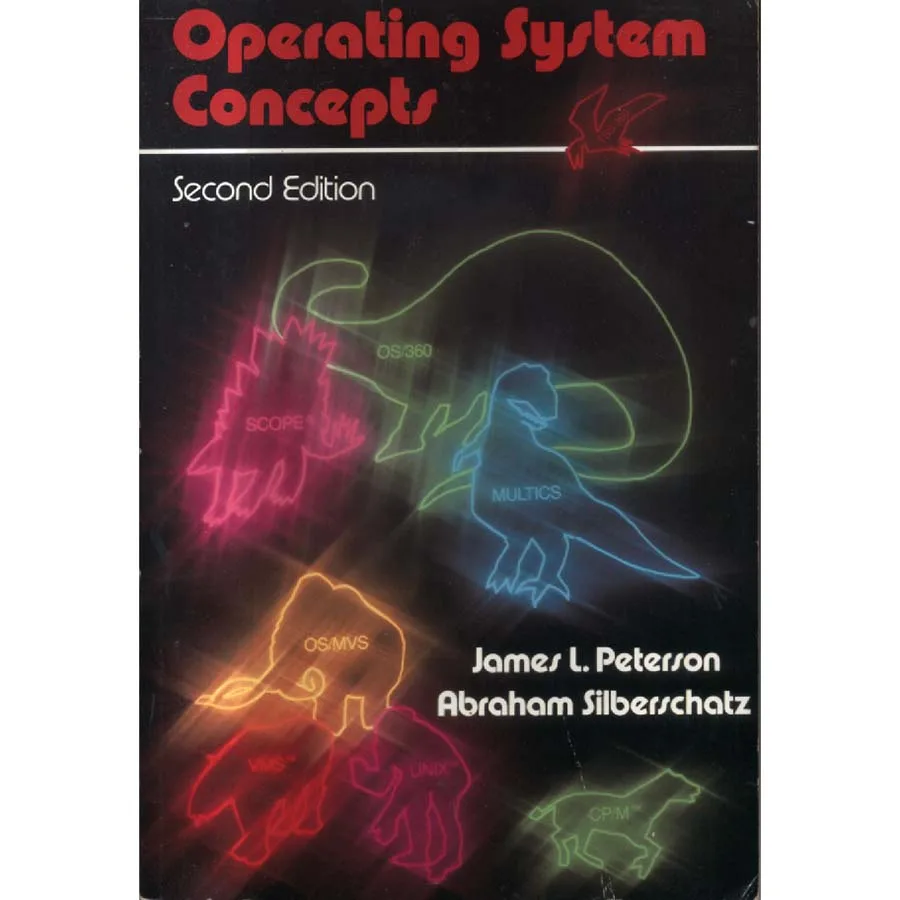
Publisher: Addison-Wesley
Format: Paperback
ISBN: 0201060795
Operating System Concepts (1983) – James Lyle Peterson and Abraham Silberschatz
Addison-Wesley | ISBN: 0201060795
Condition: Good | Sold by Crappy Old Books
Operating systems. Those magnificent pieces of software responsible for persuading millions of electronic components to cooperate, allocating resources, organising information and ensuring that computers can perform useful work without immediately descending into chaos. In theory, at least. In practice, they have also provided generations of programmers with an apparently inexhaustible supply of opportunities to stare at a screen and wonder why absolutely nothing is happening.
Welcome to Operating System Concepts, James Lyle Peterson and Abraham Silberschatz’s classic introduction to the mysterious machinery that makes computers function, published in 1983, when computing was still an activity associated with serious laboratories, expensive equipment and people who regarded a blinking terminal cursor as an exciting technological development.
Before graphical interfaces, smartphones and operating systems requiring several gigabytes merely to announce that updates are available, computers were considerably less accommodating creatures.
Memory was precious, processing power was limited, storage devices were expensive and programmers were expected to understand precisely what their machines were doing. The operating system was not simply a colourful environment filled with convenient icons. It was the essential intermediary between hardware, software and the increasingly unreasonable demands of human beings.
Peterson and Silberschatz explore the fundamental principles underlying operating-system design, including process management, memory allocation, scheduling, input and output, file systems and the coordination of competing computational tasks.
Particularly fascinating is the problem of concurrency, in which several processes attempt to use the same resources without interfering with one another.
It is rather like organising a busy railway station, except the passengers are electronic instructions, the platforms are portions of memory and an administrative oversight may cause the entire system to stop functioning.
Then there is deadlock, that splendid computational condition in which different processes wait indefinitely for resources held by one another. Anyone familiar with a committee meeting will immediately recognise the principle.
The book also examines the structures and techniques required to make computers reliable, efficient and capable of managing increasingly complicated workloads.
Published in 1983, this edition offers a fascinating snapshot of computer science during a particularly important period, when mainframes, minicomputers and emerging personal computers were reshaping the technological landscape.
Although hardware and software have advanced enormously since publication, many of the underlying principles remain central to operating-system design. Process scheduling, memory management, resource allocation and synchronisation are not merely historical curiosities; they are fundamental challenges that modern computers must still address.
For computing historians, this early edition is especially interesting as a record of how these concepts were taught before contemporary graphical environments and consumer operating systems became dominant.
This 1983 Addison-Wesley edition, offered in Good condition by Crappy Old Books, is an appealing acquisition for computer scientists, programmers, vintage computing enthusiasts and collectors of foundational technical literature.
A substantial and intellectually rewarding exploration of the systems that operate behind the scenes, performing the essential tasks without which even the most sophisticated computer would amount to an expensive collection of electronic components.
Because computers have changed beyond recognition since 1983.
Processors are faster, memory is cheaper and entire libraries can now fit inside devices smaller than a sandwich.
Yet programmers are still arguing over resources, battling unexpected errors and occasionally discovering that the computer has decided to do absolutely nothing.
Progress, apparently, is a relative concept.
Keep browsing: See more IT books Other books by James Lyle Peterson and Abraham Silberschatz
